
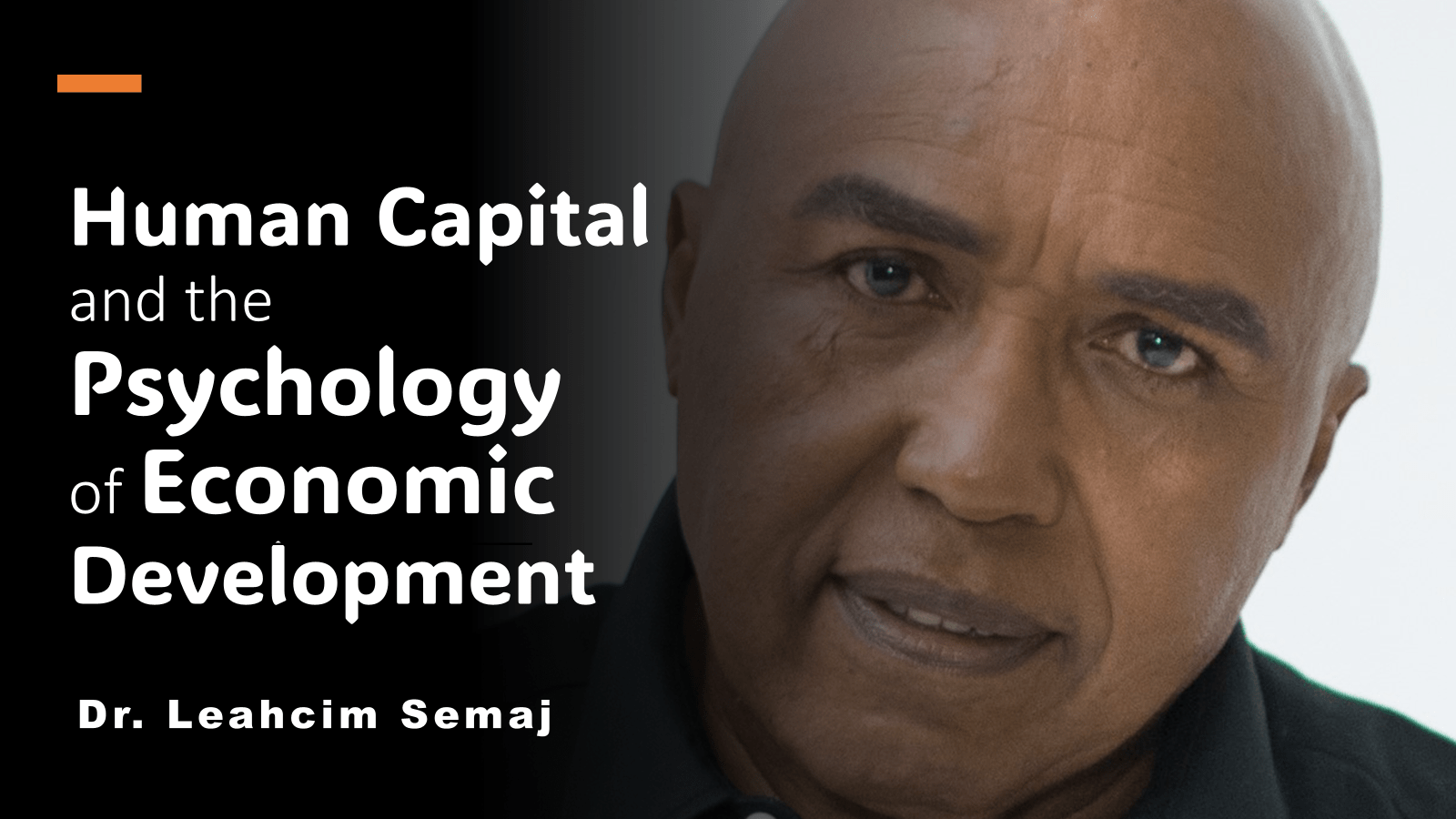
Dr. Leahcim Semaj
Psychologist | Author | Social Philosopher | Spiritual Guide | Management Consultant
What Does a Psychologist Have to Say About Economics?
Economic development is often analyzed in terms of financial investment, industrial growth, and infrastructure expansion. However, a deeper understanding of the process reveals that human capital and the psychology behind decision-making play a fundamental role in shaping economic progress. From Adam Smith’s early recognition of human capital to modern interpretations of behavioral economics, it is clear that people—not just resources—drive sustainable development.
This article explores the evolution of capital theories, the significance of human and social capital, the role of behavioral economics, and lessons from Jamaica’s community-driven economic resilience.
The Evolution of Capital: Beyond Traditional Economics
Economic thought has evolved significantly since Adam Smith, who identified four types of fixed capital:
- Useful machines and trade instruments
- Buildings that generate revenue
- Land improvements
- Human capital
Smith recognized that people’s knowledge, skills, and labor productivity were just as important as tangible assets in generating economic prosperity (Smith, 1776). This early acknowledgment laid the foundation for modern economic theories on human capital investment.
Today, economists and policymakers view capital through a broader lens. The Six Capitals Model, which builds upon Smith’s work, identifies:
- Natural Capital (environmental resources)
- Human Capital (skills, education, and well-being)
- Manufactured or Infrastructure Capital (infrastructure and tools)
- Financial Capital (monetary assets and investments)
- Political Capital (influence and governance)
- Social Capital (trust, networks, and relationships)
These six dimensions collectively determine a nation’s ability to develop and thrive. However, while physical and financial capital receive the most attention, human and social capital are the real catalysts of sustainable economic growth.
The Power of Human Capital in Economic Growth
Human capital, as defined by Theodore Schultz (1961) and later expanded by Gary Becker (1964), refers to the education, skills, health, and knowledge that individuals possess, which contribute to economic productivity. Unlike physical assets, human capital grows when nurtured through education, training, and healthcare investments.
Key Benefits of Human Capital Investment
Countries that prioritize human capital development experience:
✅ Higher Productivity and Innovation – Skilled workers drive technological progress and efficiency (Lucas, 1988).
✅ Lower Poverty and Inequality – Education and skill development reduce economic disparities (Acemoglu & Autor, 2011).
✅ Increased Economic Resilience – Countries with strong human capital recover faster from economic shocks (Hanushek & Woessmann, 2008).
Despite its importance, many developing nations underinvest in human capital, leading to brain drain, low wages, and economic stagnation. The challenge lies not just in providing education but ensuring it is relevant, high-quality, and aligned with market needs.
Behavioral Economics and Decision-Making

In 2002, Daniel Kahneman won the Nobel Prize in Economics for his research on behavioral economics, which challenges the traditional assumption that people make rational financial decisions. Instead, human behavior is shaped by:
- Present Bias – People tend to overvalue immediate rewards over long-term benefits, leading to low savings rates and underinvestment in education (Laibson, 1997).
- Herd Mentality – Social influence causes individuals to follow market trends, even if they are irrational, leading to economic bubbles (Shiller, 2000).
- Status Quo Bias – Fear of change prevents people from adopting new policies, technologies, or work strategies (Samuelson & Zeckhauser, 1988).
These psychological patterns affect everything from investment choices to workforce productivity, making it crucial to integrate psychology into economic development strategies.
The Role of Social Capital: The “Secret Sauce” of Development
What is Social Capital?
Social capital refers to the networks, relationships, and trust that bind communities together. It was first formalized by L.J. Hanifan (1916), who described it as the collective goodwill that enhances cooperation and prosperity.
The Economic Benefits of Social Capital
Communities and nations rich in social capital experience:
✅ Stronger Institutions and Governance – Trust in leaders and institutions promotes stability (Putnam, 1993).
✅ Better Economic Opportunities – Networking and collaboration foster entrepreneurship and job creation (Granovetter, 1973).
✅ Higher Levels of Civic Engagement – Citizens are more involved in shaping policies that benefit society (Fukuyama, 1995).
A compelling example comes from Native American traditions, where Chief Maquinna of the Nootka tribe described their system of reciprocal giving:
“We are Indians, and we have no such bank; but when we have plenty of money or blankets, we give them away to other chiefs and people, and by and by they return them with interest, and our hearts feel good. Our way of giving is our bank.”
This demonstrates how informal trust-based economies create sustainable prosperity—an insight valuable for modern economic strategies.
Jamaica’s Economic Development: Lessons from Human and Social Capital
Jamaica’s rural communities have long thrived on mutual support systems, such as:
- “Day-for-Day” – A labor exchange system where farmers and builders work for each other without monetary compensation.
- Community Farming and House-Building – Cooperative efforts that strengthen economic resilience.
These traditions highlight that economic success is not just about money but also about relationships and shared purpose. Similar social capital-based economies exist in parts of Africa, Southeast Asia, and the Caribbean, reinforcing the idea that community-driven development is key to sustainable growth.
Policy Implications for Jamaica and Developing Nations
To leverage human and social capital for economic development, governments must:
1️⃣ Invest in Education and Skill Development – Align training programs with industry needs to reduce unemployment.
2️⃣ Strengthen Healthcare Systems – A healthier workforce is more productive and innovative.
3️⃣ Promote Trust and Collaboration – Encourage community-driven economic initiatives and cooperative enterprises.
4️⃣ Integrate Behavioral Economics into Policy – Design policies that account for human biases to encourage saving, investment, and entrepreneurship.
Final Thoughts: Who Are You Going to Believe?
Economic theories often prioritize infrastructure and finance, but real-world progress depends on people, psychology, and community bonds.
The world’s most developed nations have not just invested in industries—they have nurtured human potential and social cohesion. The real question is:
Who are you going to believe?
1️⃣ Traditional economic models that emphasize physical and financial capital?
2️⃣ Or the growing evidence that human and social capital are the foundation of long-term prosperity?
As we move forward, integrating behavioral psychology with economic policies can unlock new pathways for growth—ones that prioritize people, trust, and sustainable development. By integrating psychology, social capital, and economic strategies, Jamaica and other developing nations can build a resilient and prosperous future.
References
- Acemoglu, D., & Autor, D. (2011). Skills, Tasks and Technologies: Implications for Employment and Earnings.
- Becker, G. (1964). Human Capital: A Theoretical and Empirical Analysis, with Special Reference to Education.
- Fukuyama, F. (1995). Trust: The Social Virtues and the Creation of Prosperity.
- Hanifan, L. J. (1916). The Rural School Community Center.
- Kahneman, D. (2002). Thinking, Fast and Slow.
- Laibson, D. (1997). Golden Eggs and Hyperbolic Discounting.
- Lucas, R. (1988). On the Mechanics of Economic Development.
- Putnam, R. (1993). Making Democracy Work: Civic Traditions in Modern Italy.
- Smith, A. (1776). The Wealth of Nations.
_________________________________________
What are your thoughts on this issue?
Let’s discuss! Leave your comments.
Signup to receive future Semaj MindSpa Blog by email to your inbox.
Schedule a 15 minute telephone meeting: https://shorturl.at/5ijpq

https://aboveorbeyondjm.com/pay-for-services/
INSPIRATION FROM THE SEMAJ MINDSPA BROUGHT TO YOU BY THE SANKORE PROFESSIONAL DEVELOPMENT INSTITUTE

Set a course for heights Above and Beyond your imagination. The 2025 Knowledge Revolution has begun. The mind has no limits!” Begin your transformation journey by visiting the Sankore Professional Development Institute website, where you can explore over 150 essential business courses designed to elevate your career.