
By Dr. Leahcim Semaj
For much of human history, people did not live long enough to worry about retirement. Many died before age 60. Others became physically incapable of productive living shortly thereafter. In fact, in 1700 the average life expectancy at birth was 35 to 40 years; by 1800 the typical adult life span was 55 to 65 years; by 1900 the numbers were 60 to 70 years. By the year 2000 the average 75 to 85 years. Much of this achieved by significantly reducing infant mortality and by the accumulated impact of modern medicine, antibiotics, vaccines, and sanitation.
Interestingly, Psalm 90:10 says:
“The days of our years are threescore years and ten; and if by reason of strength they be fourscore years…”
This is not describing life expectancy at birth. It is describing the typical lifespan of an adult who has already survived childhood, which is exactly how modern demographers analyze historical longevity.
Today, however, a growing number of people can reasonably expect to live into their 80s, 90s, and beyond. In Jamaica and throughout the world, we are witnessing the emergence of a new life stage that previous generations rarely experienced. Yet most people are completely unprepared for it.
They spend decades preparing for school, careers, marriage, parenthood, and home ownership. Very few people spend any serious time preparing for the second half of life. This may be the greatest planning mistake of all. I believe that the last 30 years of your life may turn out to be your most important years.
I have artriculated what I call the ‘Life Path’ I begin with Carl Jung’s position that state that “Life really does begin at 40. Up until then, you are just doing research. But then Vy Higginsen position was that, ‘The first 50 years are for learning and the second 50 years are for living. Life just begins when you are in your 50s,’
What I call the Life Path is this:
Birth to 40 – Research.
40 to 50- Defining your model.
50 to 100 – Living your purpose.
The New Reality of Longevity
Consider the mathematics. If you retire at 60 and live until 90, you will spend approximately one-third of your entire life in retirement. That is not a brief chapter. That is an entirely new life. This challenges many of the outdated assumptions about aging that is still carried by many.
They imagine retirement as a period of rest after a lifetime of work. A reward. A permanent vacation. A long Sunday afternoon. But anyone who has worked with retirees knows a different reality. The question is not: “How will I stop working?” The question is: “What will I do with the next 30 years of my life?” That answer determines whether retirement becomes a period of growth or stagnation and decline.
The Retirement Myth
One of the most damaging myths ever sold to modern society is the belief that retirement is the finish line. It is not. Retirement is a transition. Many people retire from their jobs but never retire into a meaningful life. The result is predictable. Without structure, purpose, relationships, or challenge, many experience:
- Depression
- Isolation
- Loss of identity
- Declining health
- Reduced cognitive functioning
Their careers ended. Unfortunately, so did much of their reason for getting up in the morning. Human beings need more than comfort. We need meaning. The goal should never be simply to retire. The goal should be to redesign life. This process is described in detail in my book: “The Best is Yet to Come: A Psychologist’s Guide for Thriving in Retirement,” https://rb.gy/b8mebz
The Four Capitals That Determine Your Future
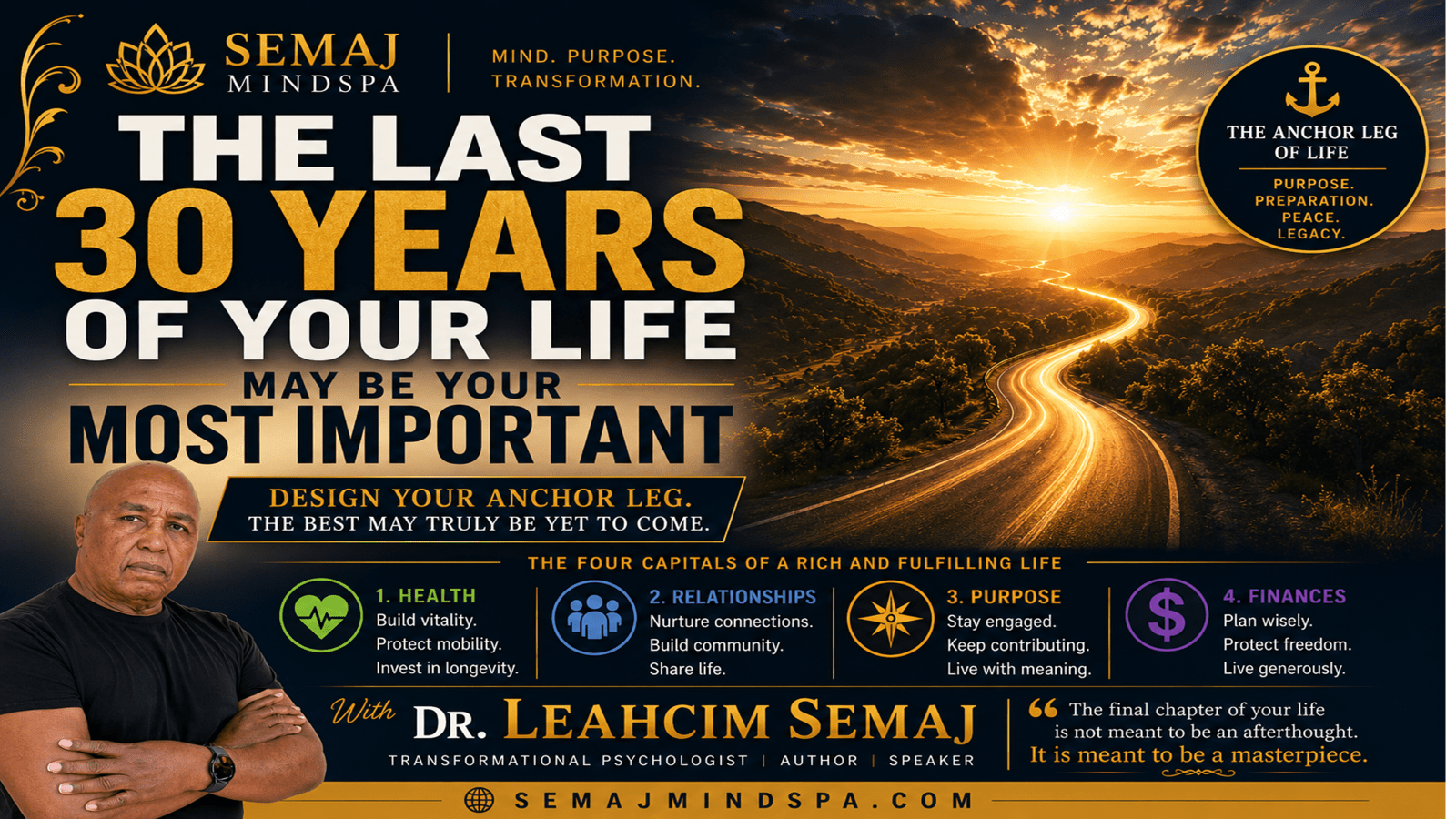
The quality of your Anchor Leg of Life is determined less by your age and more by the strength of four forms of capital. Most people focus almost entirely on one: Money. The is what the pension fund managers focus on. Yet money alone is insufficient. The most successful older adults invest in four capitals simultaneously.
Capital #1: Health Capital
Health is the foundation upon which everything else rests. I always ask; “if you don’t take care of your body, where are you going to live?” Without health, relationships become difficult. Purpose becomes harder. Travel becomes limited. Independence disappears.
There is a common statement that many people spend their youth consuming their health in pursuit of wealth. Then spend retirement consuming their wealth trying to regain their health. There is a better way.
Your Centenarian Decathlon
This was first articulated be Dr. Peter Attia in his best seller; “Outlive: The Science and Art of Longevity”. Imagine that your goal is not merely to live longer. Imagine your goal is to live well at 100. What are the things that you would like to still be able to do in what he calls your ‘marginal decade’, the last ten years of your life. What abilities would you need? Can you:
- Walk comfortably?
- Climb stairs?
- Lift moderate weight?
- Maintain balance?
- Carry groceries?
- Get up from the floor independently?
- Think clearly?
- Hear and see adequately?
- Maintain mobility?
- Stay socially engaged?
These become the type of events in what is call the Centenarian Decathlon. What you do is train for these abilities now. Longevity without functionality is not the objective. The objective is vitality. You will become ‘old and fragile’ if you chose not to be intentionally ‘old and agile’.
Capital #2: Relationship Capital
The longest-running studies on human happiness consistently reveal a simple truth: Relationships matter more than almost everything else. Not wealth. Not status. Not possessions. Relationships. My wife frequently reminds people that ‘you can’t send hot water through the post office’, there are time that you need someone close enough to make you a cup of tea.
Many people reach retirement having accumulated money but neglected friendships. Others discover their entire social life was built around work. Once the job ends, the relationships disappear. This creates a dangerous form of loneliness. One that affects mental health, physical health, and even longevity itself. The question is not how many people know your name. The question is: Who would notice if you disappeared for a week?
Strong relationship capital includes:
- Family connections
- Friendships
- Community involvement
- Mentorship
- Spiritual connections
- Meaningful companionship
Relationships are not luxuries. They are life support systems.
Capital #3: Purpose Capital
Many retirees underestimate how much of their identity came from work. The title disappears. The office disappears. The responsibilities disappear. Suddenly the question emerges: Who am I now?
Purpose answers that question. Purpose does not necessarily mean paid employment. It means contribution. Teaching. Mentoring. Creating. Serving. Building. Growing. Writing. Leading. Helping. Learning.
The human spirit thrives when it feels useful. People rarely become old because of age alone. Many become old because they stop growing. Purpose keeps growth alive.
Capital #4: Financial Capital
Money matters in this day and age. Anyone who says otherwise has probably never worried about paying bills. Financial capital provides options in all the important areas: Healthcare. Housing. Travel. Experiences. Security. Peace of mind.
However, financial capital should support life and not replace it. Some individuals spend decades accumulating money while neglecting every other form of capital. Then they discover an uncomfortable truth: Money can purchase comfort but it cannot purchase health, purpose, or genuine love. Financial preparation remains essential. But it is only one part of a larger equation.
Designing Your Anchor Leg
In relay racing, the anchor leg is often entrusted to the strongest runner. The one responsible for bringing the team home. I believe that life works similarly. The final decades deserve intentional design. Ask yourself:
- Where will I live?
- How will I maintain my health?
- Who will I spend time with?
- What will give my days meaning?
- How will I continue learning?
- How will I contribute?
- What legacy will I leave behind?
Most people drift into retirement. Few design it. The difference is enormous. A well-designed Anchor Leg can become a period of unprecedented freedom, wisdom, impact, and fulfillment.
Why the Best May Truly Be Yet to Come
Society often treats aging as decline. I disagree. I chose to ‘sage’. not just age. For me, this transition also represent liberation. You know yourself better. You care less about impressing others. You possess decades of accumulated wisdom. You have survived failures, heartbreaks, disappointments, and victories. You understand what truly matters. For perhaps the first time in your life, you can begin to align your time with your deepest values.
That is not decline. That is evolution. The final chapter of life is not meant to be an afterthought. It is meant to be a masterpiece. The challenge is not simply to live longer, it is to live better. To invest intentionally in your health, relationships, purpose, and finances. To design an Anchor Leg worthy of your life experience. If you do that well, you may discover something remarkable:The best is not behind you.The best may truly be yet to come.
