
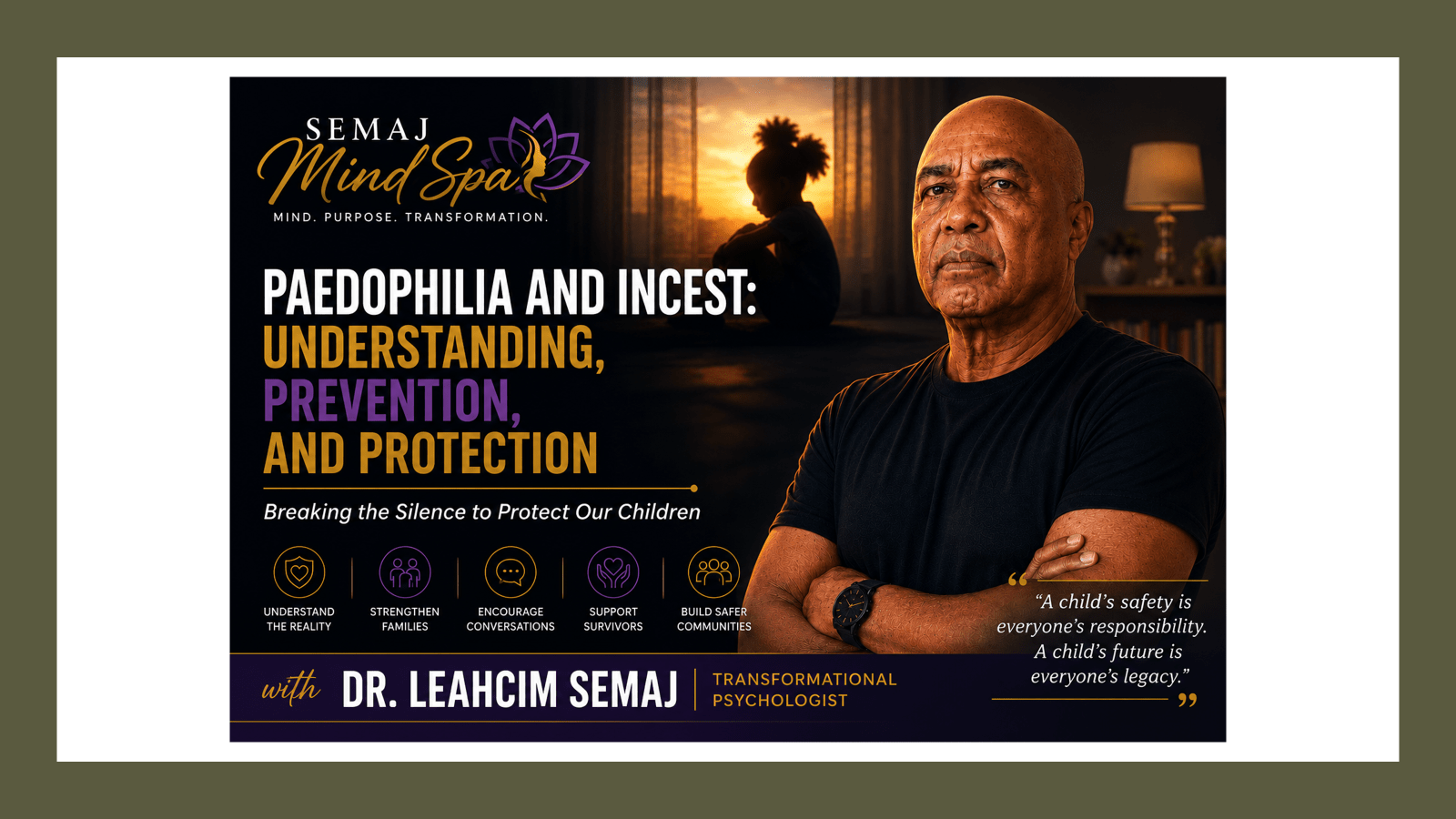
Breaking the Silence to Protect Our Children
By Dr. Leahcim Semaj
Transformational Psychologist
There are few subjects that generate more discomfort than child sexual abuse. We instinctively want to turn away, believing that such horrors belong somewhere else – to other families, other communities, other countries. Yet silence has never protected a child. Knowledge has.
If we are serious about safeguarding children, we must be willing to discuss difficult realities with honesty, compassion, and scientific understanding. This conversation is not about creating fear or encouraging suspicion of everyone around us. It is about recognising risk, understanding how abuse occurs, supporting survivors, and creating families and communities where children are genuinely safe.
Every child deserves to grow up in an environment where love is never confused with exploitation and trust is never weaponised.
Naming the Subject: Definitions and Distinctions
The first step in any meaningful conversation is using the correct language.
The term paedophilia refers to a psychiatric condition characterised by a persistent sexual attraction to prepubescent children. It is a clinical diagnosis, not a synonym for child sexual abuse.
Child sexual abuse refers to the criminal act of involving a child in sexual activity. Every act of child sexual abuse is a profound violation of a child’s rights, safety, and dignity.
The term incest describes sexual activity between close family members. In practice, many incest cases involve adults abusing children within the family system. Others may involve older adolescents exploiting younger children. What defines incest is not simply biology but the betrayal of family boundaries and the abuse of trust.
These distinctions matter because effective prevention depends upon understanding both psychological realities and criminal behaviour without confusing the two.
Inside the Family System
Families are meant to be the safest places in a child’s life. Home is where children learn trust, security, belonging, and identity. When abuse occurs within that environment, it creates a profound psychological injury because the very people responsible for protection become the source of danger.
One of the most difficult truths to accept is that many children who experience sexual abuse know the person responsible. The offender may be a parent, step-parent, sibling, uncle, aunt, grandparent, cousin, neighbour, coach, teacher, family friend, or another trusted adult.
This reality challenges the popular image of the unknown stranger lurking outside the home. While stranger danger remains a legitimate concern, the greater challenge for many families is recognising that abuse often occurs within relationships built on trust and familiarity.
Child sexual abuse is fundamentally about the misuse of power. Adults possess authority, experience, physical strength, and emotional influence that children simply cannot match. That imbalance makes genuine consent impossible.
Why These Things Stay Hidden
Perhaps the greatest ally of abuse is silence. Many survivors never disclose what happened during childhood. Others wait years, even decades, before speaking. Why? Because children often experience conflicting emotions. They may love the person abusing them. They may fear punishment. They may believe no one will believe them. They may have been threatened. They may fear breaking up their family.
Many offenders use a process known as grooming. Grooming is rarely dramatic. It often begins with attention, affection, gifts, special privileges, or gradually crossing personal boundaries until inappropriate behaviour has become normalised for the child. This is one reason prevention must focus not only on teaching children about body safety but also on educating adults about the subtle warning signs of grooming and inappropriate boundary violations.
Communities sometimes unintentionally contribute to silence by protecting family reputation, social status, or institutional prestige above children’s wellbeing. Protecting children must always take precedence over protecting appearances.
The Weight Carried: Trauma and Healing
Childhood sexual abuse is not simply an event that ends when the abuse stops. It is an experience that can shape the way survivors understand themselves, relationships, trust, intimacy, and safety. Many survivors experience symptoms associated with trauma, including anxiety, depression, hypervigilance, difficulties trusting others, emotional dysregulation, shame, or challenges in forming healthy relationships. Some develop remarkable resilience despite these experiences, while others continue to struggle for many years.
No two survivors respond in exactly the same way. One of the greatest misconceptions is asking, “Why didn’t they tell sooner?” The more compassionate question is:
“What made it so difficult to tell?”
Healing begins when survivors encounter environments where they are believed, respected, and supported. Trauma-informed counselling, stable relationships, supportive families, and communities willing to listen without judgement all contribute to recovery. Survivors are not defined by what happened to them. They are far more than the trauma they endured.
Community, Culture and Caribbean Context
Every society carries cultural strengths. Every society also carries cultural blind spots. Across the Caribbean, respect for elders and close family ties are deeply valued traditions. These strengths often nurture resilient communities. Yet those same traditions can become vulnerabilities when unquestioning obedience discourages children from challenging inappropriate adult behaviour or when family loyalty discourages disclosure.
Shame also plays a significant role. Families may worry about embarrassment. Communities may fear scandal. Institutions may become defensive rather than transparent. When protecting reputations becomes more important than protecting children, everyone loses. The challenge for Caribbean societies is not to abandon our values but to strengthen them. Respect should never mean silence. Family loyalty should never require secrecy about abuse. Faith should never excuse exploitation. Our cultural values are strongest when they place the wellbeing of children above every other consideration.
Protection and Prevention: What Actually Helps
There is no single strategy that eliminates child sexual abuse. Protection requires multiple layers working together. Parents can begin by creating homes where children feel emotionally safe enough to ask difficult questions and report uncomfortable experiences. Children should be taught, in age-appropriate ways:
- That their body belongs to them.
- That they have the right to refuse unwanted touching.
- That no adult should ask them to keep sexual secrets.
- That they will never be punished for reporting something that makes them uncomfortable.
- That trusted adults will listen and help.
Schools, churches, sports organisations, youth clubs, and community groups should have clear safeguarding policies, careful screening of adults working with children, regular training, and transparent reporting procedures. Communities must move away from asking whether abuse could happen in “our family” or “our church.” The more useful question is:
“Have we created systems that make abuse more difficult to occur and easier to detect?”
Breaking the Silence
Perhaps the greatest lesson is this: Protecting children is not only the responsibility of parents. It belongs to teachers. Healthcare professionals. Religious leaders. Police officers. Neighbours. Extended families. Friends.
Every responsible adult has a role to play. Children rarely possess the power to protect themselves from adults. That responsibility belongs to us. A civilisation is ultimately judged not by its wealth, its technology, or its monuments, but by how faithfully it protects those who are least able to protect themselves.
If this conversation encourages one parent to ask an important question, one teacher to notice a warning sign, one survivor to seek support, or one child to speak when they previously remained silent, then breaking the silence will have served its purpose. Because every child deserves something that should never be negotiable: To be safe. To be believed. To be protected. To be loved without fear.
MindSpa Reflection
“The measure of a society is not how loudly it condemns abuse after it is discovered, but how intentionally it prevents abuse before it occurs. Child protection begins with informed adults, courageous conversations, and communities that choose truth over silence.”
