
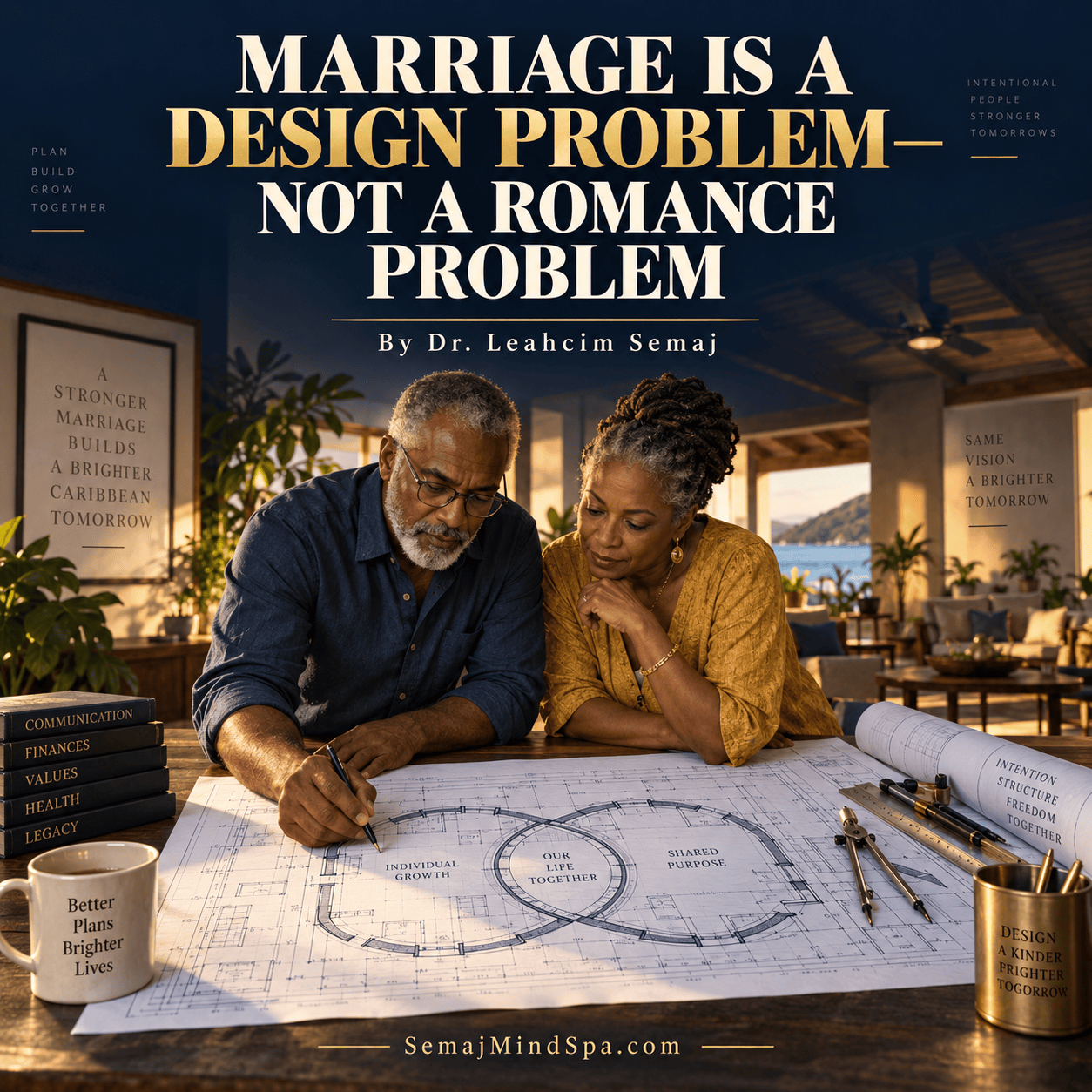
Love may bring two people together. It does not automatically teach them how to build a life.
By Dr. Leahcim Semaj – Psychologist | Author | Relationship Architect
The Semaj MindSpa — Where Mind, Spirit, and Science Meet
We have been sold a beautiful but incomplete story about marriage. Find the right person. Fall deeply in love. Make the commitment. Then, if the love is genuine, the relationship will somehow take care of itself. It sounds comforting. It may even feel true during courtship, when attention is generous, desire is fresh and both people are presenting some of their best selves. But marriage is not lived mainly in candlelight. It is lived in traffic, kitchens, bank accounts, bedrooms, family gatherings, medical waiting rooms and ordinary Tuesdays when both people are tired.
This is why I have come to believe that many marriages do not collapse because there was never any love. They collapse because there was never enough design. Love is an emotion, a bond and sometimes a powerful decision. Marriage, however, is also a system. And systems need design, architecture and maintenance.
Why Love Alone Is Not Enough
Love can make us willing. It cannot, by itself, make us skilled. Two people may genuinely love each other and still be unable to discuss money without fighting. They may care deeply and yet have completely different expectations about sex, privacy, parenting, religion, friendship, household labour or support for ageing parents. They may both be decent people while operating from incompatible definitions of loyalty and partnership.
Love does not automatically create emotional maturity. It does not settle questions about who carries the mental load, how decisions are made or what happens when one partner’s career begins to consume the marriage. It does not teach repair after hurt. It does not guarantee that affection will survive years of neglect. This is not an argument against romance. Romance is important. It adds pleasure, tenderness, play and erotic energy to the relationship. A marriage without romance may become a corporation with a bedroom attached.
But romance cannot carry the full weight of a shared life. When the bills arrive, a child gets sick, one partner loses a job, menopause or illness changes sexual life, or an elderly parent needs daily care, the marriage requires more than feeling. It needs agreements, habits, boundaries, communication and a method for responding to change. In other words, it needs structure.
Romance Is the Spark. Structure Is the Fireplace. Fires Need Tending.
Romance asks, “How do we feel about each other?” Structure asks, “How will we live with each other?”
Romance enjoys spontaneity. Structure protects what matters by making room for it.
Romance says, “We should spend more time together.” Structure puts protected time on the calendar.
Romance says, “I will always be there for you.” Structure defines what support actually looks like when one person is exhausted, grieving, overwhelmed or afraid.
The distinction matters because couples often try to solve structural problems with romantic gestures. A weekend at a hotel may temporarily soften a relationship strained by chronic imbalance. Flowers may create a pleasant evening. Neither will resolve years of financial secrecy, sexual avoidance, poor boundaries with relatives or one partner doing nearly all the emotional work. The gesture is not the problem. The absence of redesign is.
The Principles of Relationship Architecture
A well-designed marriage is not rigid. Good architecture creates both stability and room to move. It anticipates pressure, distributes weight and can be renovated when the needs of its occupants change. The same is true of relationships.
1. Shared Purpose
Every marriage needs an answer to a deceptively simple question: What are we building together? The answer cannot be merely “a house,” “children” or “financial security.” Those may be important projects, but they do not fully describe the relationship.
What kind of home are you trying to create? What values will govern it? How should each person grow because this marriage exists? A couple without shared purpose may remain busy together while slowly travelling in different directions.
2. Clear Expectations
Unspoken expectations are among the most dangerous materials in any marriage. One person may believe that a good spouse should automatically know when help is needed. The other may believe that mature adults should ask directly. One may treat private messages with an ex-partner as harmless. The other may regard them as betrayal. One assumes that income is shared. The other assumes that financial independence means financial privacy. Neither romance nor a marriage certificate settles these matters. They must be discussed.
3. Fair, Not Necessarily Equal Distribution
Every household contains visible work and invisible work. Somebody remembers the appointment, notices the child’s distress, keeps track of the groceries, maintains contact with relatives and senses when the relationship is drifting. Healthy couples examine how the load is carried. The goal is not a mechanical fifty-fifty division every day. Life rarely works that neatly. The goal is fairness, reciprocity and the confidence that one person’s contribution is not being taken for granted.
4. Decision Rules
How does this marriage make decisions? Does the person earning more money have more power? Does one partner avoid conflict until the other gives up? Are major choices discussed, or are inconvenient facts announced after the decision has already been made?
Couples need a method for handling decisions about money, children, work, relocation, relatives and lifestyle. Without an agreed process, power will usually go to the loudest, wealthiest, most persistent or most emotionally difficult person. That is not partnership. It is an informal hierarchy.
5. Boundaries That Protect the Marriage
A marriage must have doors as well as windows. Friends, children, parents, former partners, church communities and digital devices all require appropriate boundaries. In the Caribbean, extended family can be a magnificent source of strength. It can also become a third party in the marriage when access, money, loyalty and influence are never clearly negotiated. Boundaries are not rejection. They clarify where responsibility begins and ends.
6. A Repair System
Conflict is not evidence that a marriage is badly designed. The more important question is what happens after the conflict. Can either person admit fault without adding an excuse? Can they disagree without humiliation, threats or withdrawal used as punishment? Is there a pathway back to safety? Can an apology lead to changed behaviour—or is “sorry” simply the fee paid to repeat the offence? Every durable marriage needs a repair process. Love gets injured. Trust can be weakened. Good intentions are not enough. Repair must be visible.
7. Planned Intimacy
Couples often expect intimacy to remain spontaneous while their lives become increasingly scheduled. (Wishful thinking). Work has a calendar. The children have a calendar. Church, exercise, medical appointments and social events have calendars. The marriage gets whatever energy is left. Then both people are surprised when friendship thins and sexual connection fades.
Planned intimacy is not artificial. It is an acknowledgement that what matters must be protected. Conversation, touch, play, privacy and sexual connection need attention, not pressure, but attention.
8. Regular Renovation
The marriage you designed at 30 may not fit at 50. The partnership that worked while raising children may feel empty when the children leave. Retirement, illness, migration, caregiving and success can each change the balance of a relationship.
Couples should periodically ask: What is working? What has become unfair? What do we now need more of? What must we stop doing? Who are we becoming? You do not renovate only because the building is collapsing. Sometimes you renovate because life has changed.
Designing Instead of Drifting
Most couples do not consciously choose a dysfunctional pattern. They drift into one. One person gradually takes over the finances. The other quietly withdraws from sexual intimacy. Work expands into the space once reserved for companionship. Conversations become logistical briefings: Who is collecting whom? What needs to be paid? What time will you be home?
Nothing dramatic may happen. There may be no affair, no major explosion and no single villain. Yet the marriage becomes less alive each year. Drift is dangerous precisely because it does not always feel like a crisis. Design interrupts drift. It requires two people to look honestly at the relationship they actually have—not the one they display publicly, remember nostalgically or keep promising they will create “when things settle down.”
The conversation may be uncomfortable. Good design often begins with uncomfortable measurements. Ask yourselves:
- What is this marriage currently designed to produce?
- Who benefits most from the present arrangement?
- Where is resentment accumulating?
- What important need has no protected space?
- Which agreements have never been spoken aloud?
- What would we deliberately redesign if we were starting this phase today?
These are not questions only for couples in trouble. They are questions for couples who want to remain awake.
The Semaj MindSpa Takeaway
Marriage is not rescued by romance alone. Nor is it strengthened simply by staying together for a long time. Longevity can indicate devotion, but it can also conceal habit, fear, dependency or emotional resignation. A flourishing marriage is consciously built, and repeatedly rebuilt.
Choose love, certainly. Protect romance. Laugh together. Touch often. Create memories. But also discuss the plumbing: money, power, labour, sex, family, boundaries, conflict, health, ageing and the future. Do not wait for a crisis to examine the architecture. Love may bring you into the house. Design determines whether the two of you can live well inside it.
Relationship Architecture Consultation
If your relationship feels loving but strained, stable but stagnant, or committed but poorly organised, the problem may not be the absence of love. The structure may need attention. A Relationship Architecture Deep Dive Consultation is a focused, confidential deep dive into how your relationship currently works. Together, we identify the patterns, expectations, pressure points and missing agreements that may be weakening the partnership – and begin designing a more intentional way forward. This is not about assigning blame. It is about understanding the system the two of you have created and deciding whether it still serves the life you want to build.
To enquire or schedule a Relationship Architecture Consultation, visit SemajMindSpa.com.
The Best Is Yet to Come.